
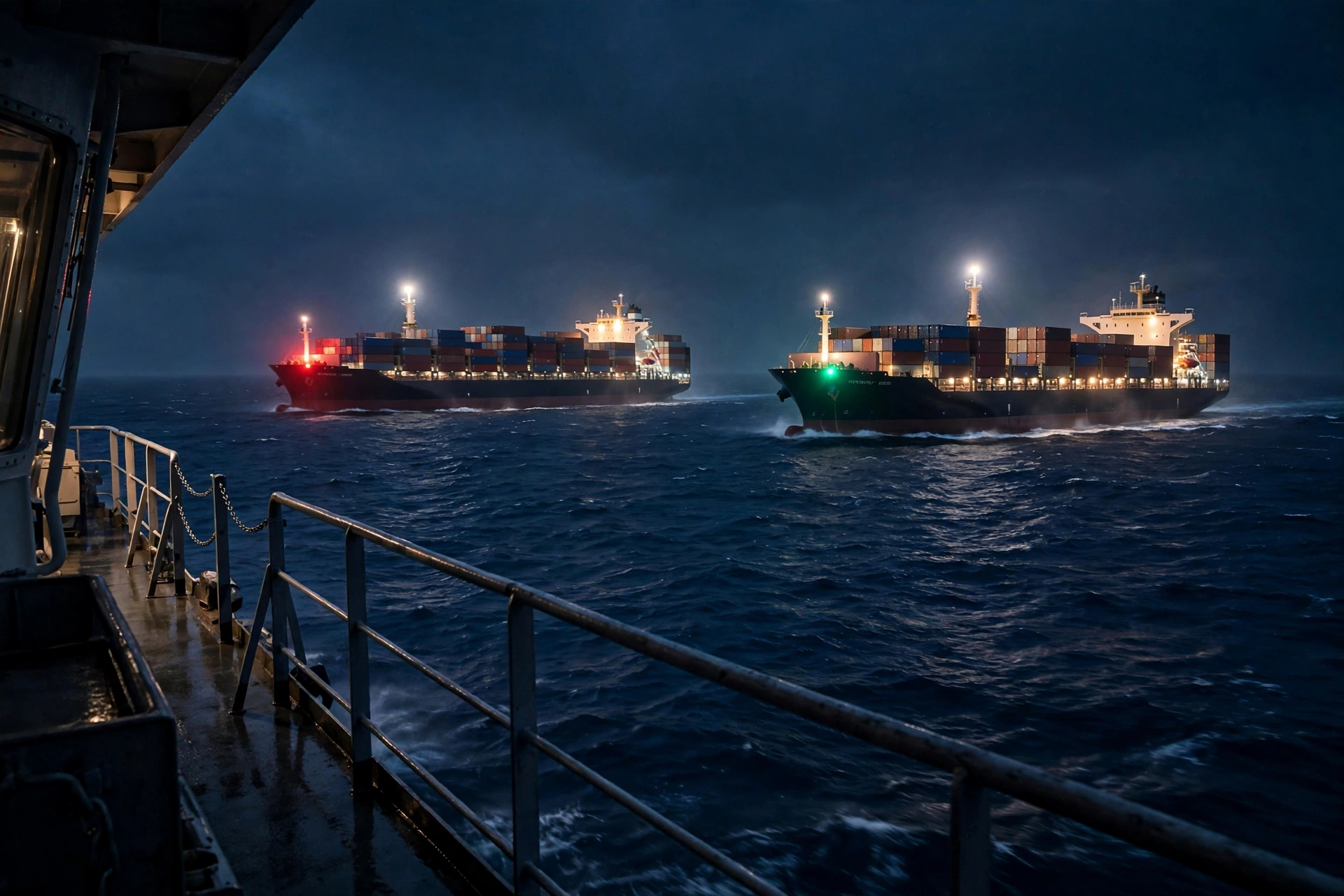

COLREG — the Convention on the International Regulations for Preventing Collisions at Sea, 1972 — is the set of rules of the road at sea, published by the IMO and applying to every vessel on the high seas. Who gives way, who stands on, which lights to show, and which sound signals to sound: all of it is in COLREG’s 41 rules. This interactive quiz tests the 12 rules that come up most in ANT/ATT exams, Marlins tests, and — most importantly — on a real bridge watch.
How to play: pick the answer you think is correct. Answers are corrected instantly and each question has an explanation.
Quick Table: 12 Key COLREG Rules Tested Here
| Rule | Short Version |
|---|---|
| Rule 7 — Risk of Collision | A compass bearing of an approaching vessel that does not appreciably change = risk of collision is deemed to exist |
| Rule 10 — Traffic Separation Schemes | Cross a traffic lane as nearly as practicable at right angles to the general direction of traffic flow |
| Rule 13 — Overtaking | A vessel overtaking (from more than 22.5° abaft the beam) shall keep out of the way until finally past and clear |
| Rule 14 — Head-on Situation | Two power-driven vessels meeting head-on: both alter course to starboard, pass port to port |
| Rule 15 — Crossing Situation | The vessel which has the other on her own starboard side is the give-way vessel |
| Rule 16 — Action by Give-way Vessel | Take early and substantial action to keep well clear of the other vessel |
| Rule 17 — Action by Stand-on Vessel | Keep course and speed; take action if the give-way vessel does not |
| Rule 18 — Responsibilities Between Vessels | A power-driven vessel shall keep out of the way of NUC, RAM, fishing vessels, and sailing vessels |
| Rule 27 — NUC & RAM | NUC: two all-round red lights in a vertical line; RAM: red–white–red in a vertical line |
| Rule 30 — Anchored Vessels | An all-round white light; by day, one black ball |
| Rule 34 — Manoeuvring Signals | One short blast = altering to starboard; two = to port; three = astern propulsion; five = doubt/danger |
| Rule 35 — Sound Signals in Restricted Visibility | A power-driven vessel making way: one prolonged blast at intervals of not more than 2 minutes |
Interactive Quiz — Test Yourself
Read the table above? Test yourself with the 12 questions below. Every answer is corrected instantly with an explanation:
Quiz: COLREG — Rules of the Road at Sea
12 questions — instant correction + explanations
Why COLREG Matters for Indonesian Seafarers
- Exams and selection. COLREG questions appear in ANT/ATT exams, Marlins and CES tests, and foreign crewing-company interviews — especially head-on, crossing, and overtaking scenarios.
- Bridge watch. On the bridge, the decision of who gives way and who stands on must be made in seconds. Rules 14, 15, and 17 are the ones used most.
- There is no “right of way” at sea. COLREG has no right of way as on a road — only a duty to keep out of the way (give-way) and a duty to keep course and speed (stand-on), and both must act when a collision can no longer be avoided.
- Lights and sound signals are the language of ships. Two red lights in a vertical line, red–white–red, one prolonged blast in fog — every other vessel reads them from far away, day and night.
More practice: try the Maritime English (SMCP) quiz and check the 2026 seafarer salary guide before choosing your next rank.
Get your CV ready before applying: read the seafarer CV guide that crewing notices — or if you want help writing one, chat with us on WhatsApp at +62 896-5739-1260.
Sources: IMO — Convention on the International Regulations for Preventing Collisions at Sea, 1972 (COLREG), 41 rules; U.S. Coast Guard — International Navigation Rules (2024), official text of Rules 7, 10, 13–18, 27, 30, 32, 34, 35; IALA COLREG — summaries of Rules 1–41 and sound-signal tables (November 2026 edition).