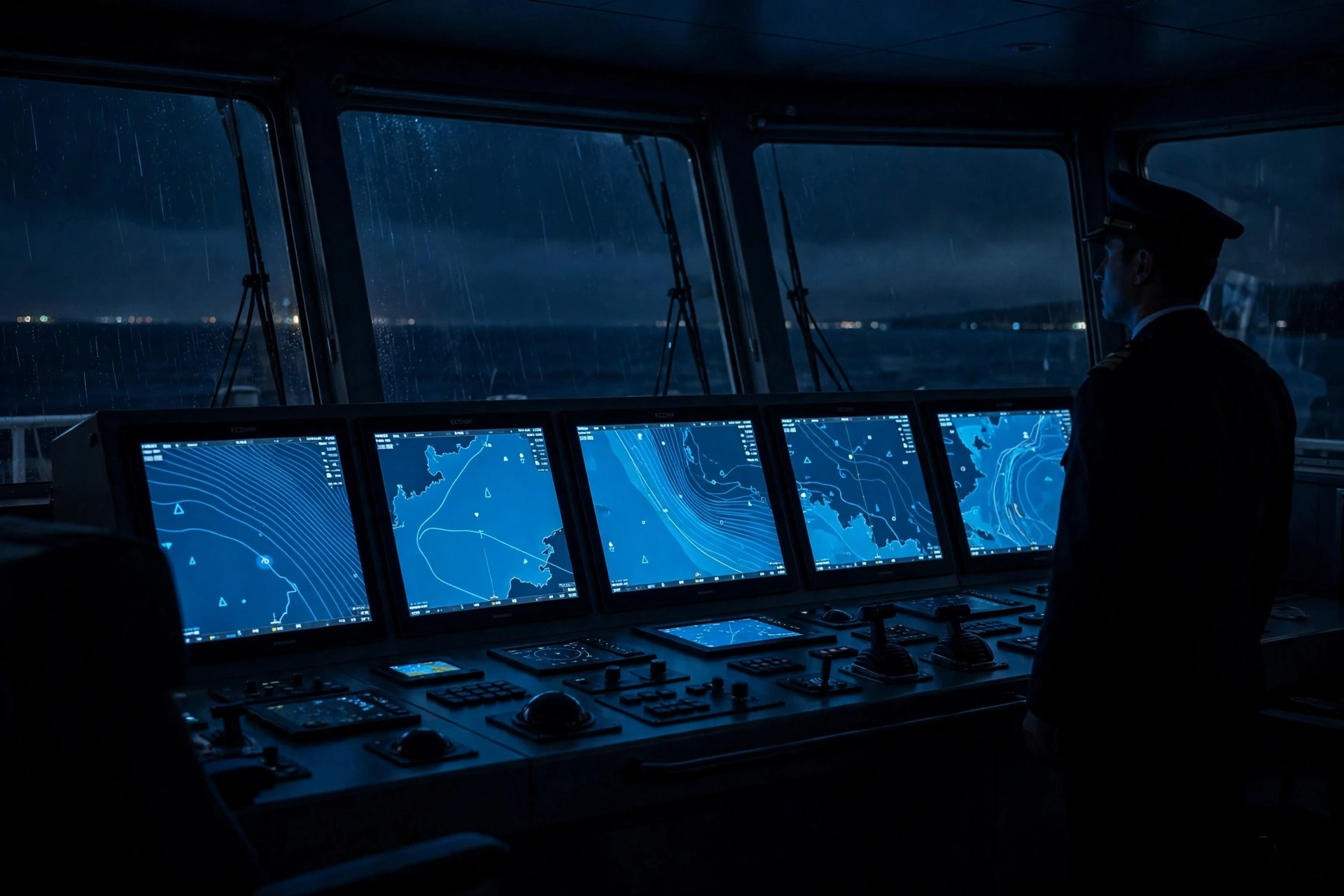

ECDIS (Electronic Chart Display and Information System) is the electronic chart system that is now the primary navigation tool on almost all merchant ships worldwide. For Indonesian officers sailing on foreign vessels, understanding ECDIS is no longer a bonus — it’s a job requirement. This article summarizes the mandatory rules, how it works, and the traps that still run ships aground despite ECDIS.
Legal Basis: When Is ECDIS Mandatory?
The ECDIS carriage requirement is set by SOLAS Chapter V Regulation 19. The 2009 amendments (effective 1 January 2011) require ECDIS on passenger ships of 500 GT and above and cargo ships of 3,000 GT and above on international voyages, with phased implementation for new and existing ships. Important: only type-approved ECDIS (IMO standards MSC.232(82)/MSC.530(106), tested per IEC 61174), using official up-to-date ENCs, and fitted with a backup arrangement may fully replace paper charts.
ENC vs RNC vs Paper Charts
Not every “digital chart” counts. Only official charts — issued by or under the authority of a government hydrographic office — may be used as the basis of navigation:
| Type | Format | Notes |
|---|---|---|
| ENC | Vector database (S-57) | Official. Layers can be managed; the system can raise automatic danger alarms. |
| RNC | Scanned (raster) paper chart | Official; used where ENCs are unavailable or their scale is inadequate for the area. |
| Private / unofficial charts | Various formats | NOT recognized by SOLAS as a basis for navigation. |
Per SOLAS V/27, all charts for the intended voyage must be adequate and up to date — including electronic ENC updates and the latest Notices to Mariners.
Main ECDIS Functions
- Route planning + automatic route check against dangers (check route).
- Route monitoring with alarms: safety contour, cross-track limit, and danger warnings.
- Bridge sensor integration: GPS, gyro, speed log, AIS, even radar overlay.
- Electronic chart updates far faster than manual paper chart corrections.
ECDIS Traps — Why Do Ships Still Run Aground?
Accident investigations (e.g. by the UK MAIB) coined the term “ECDIS-assisted grounding”: ships run aground NOT for lack of ECDIS, but because ECDIS is misused. The most common traps:
- Over-reliance: trusting the screen so much you forget to look out the window and cross-check with visual, radar, and echo sounder.
- Safety contour set wrong: a real example — a 30 m contour made shallow patches hard to see and the anti-grounding alarm never sounded.
- Alarms switched off: one case had a second officer crossing a 10 m safety contour with no reaction because the ECDIS alarm was muted.
- Alarm fatigue: so many alarms that all get ignored (improved since IHO Presentation Library 4.0, but stay alert).
- Low CATZOC: the Category Zone of Confidence (A1 best to D worst) shows survey data quality. In CATZOC C/D areas, coastlines and depths may not be accurate.
- Different type, different operation: 30+ type-approved ECDIS systems with different operating procedures. Not mastering the type on your ship = dangerous.
- Route never checked with the check-route function, and the master unable to operate the ECDIS to verify it.
Recent data reinforces this: the NorthStandard ECDIS Training Assessment report (based on 5,000+ bridge team assessments since February 2024) found that the mandatory ECDIS certificate does NOT automatically mean competence in operating it — the biggest gaps are in safety contour, alarms, ENC updates, and passage plan verification.
Training Requirements
The IMO requires two layers of training: generic ECDIS training (per IMO Model Course 1.27) AND type-specific training for the make/model of ECDIS fitted on the ship where you serve. Both are required before you take on navigational watch duties.
Practical Checklist for Indonesian Officers
- Ensure ENCs are up to date (electronic updates + latest Notices to Mariners) before departure.
- Set the safety contour to match the ship’s draught and the company’s UKC policy.
- Run check-route / route validation — don’t just draw a line.
- Keep alarms active and unmuted; manage them to avoid alarm fatigue.
- Check CATZOC in confined and shallow areas.
- Master the ECDIS type on your ship (take its type-specific training).
- Always cross-check: visual lookout, radar, echo sounder. ECDIS is an aid, not a substitute for vigilance.
- Prepare and master the backup arrangement (second ECDIS or paper charts) and the changeover procedure.
Interactive Quiz — Test Your Understanding
Read the material? Test yourself with the 8 questions below. Every answer is corrected instantly with an explanation:
Quiz: ECDIS for Officers
8 questions — instant correction + explanations