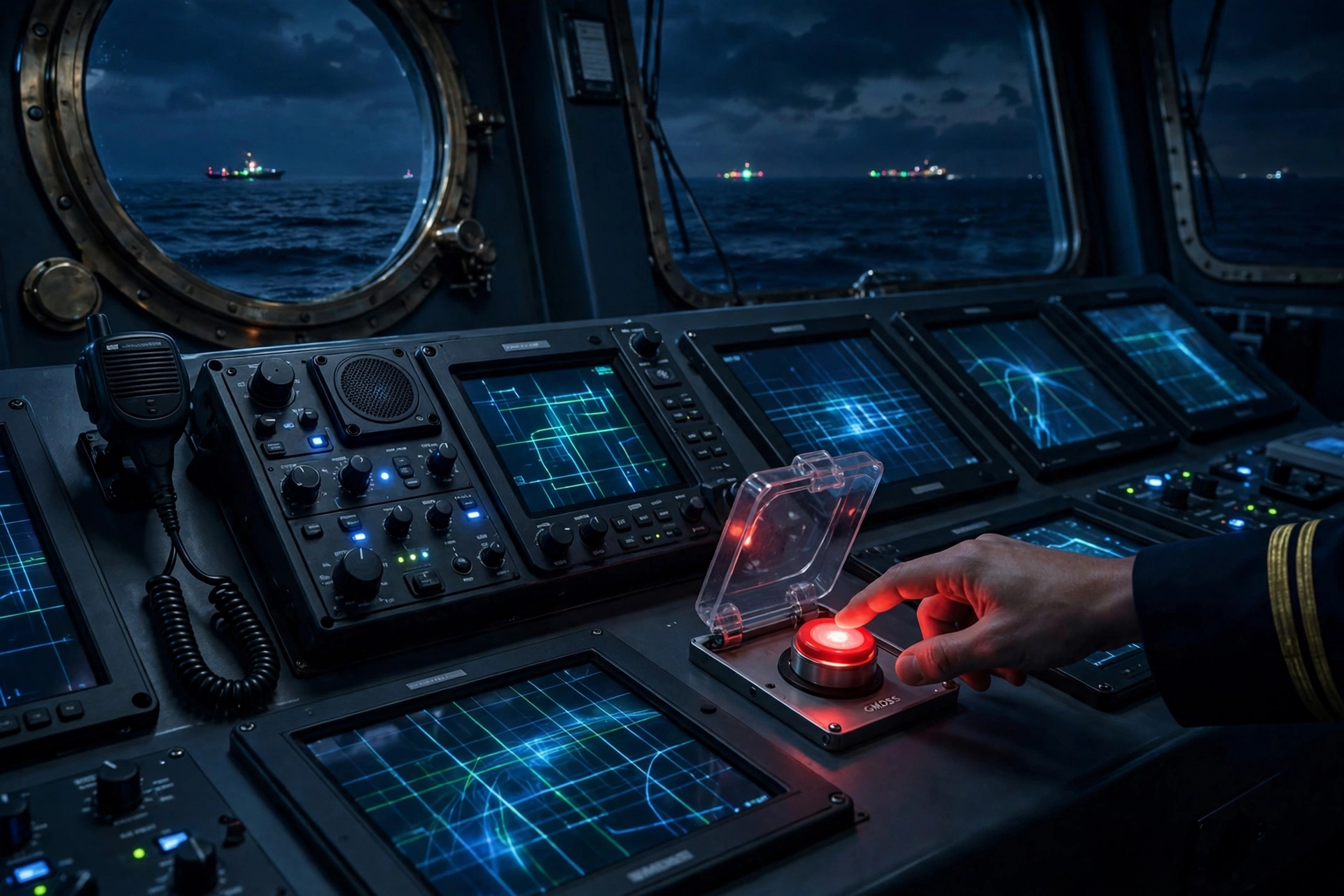

GMDSS — the Global Maritime Distress and Safety System — is the ship distress and safety communication system set out in SOLAS Chapter IV, fully in force since 1 February 1999. Since then, a ship in trouble no longer depends on someone hearing a Morse key — one press of the DSC button sends the ship’s position and identity straight to coast stations and nearby vessels. From 1 January 2024, SOLAS Chapter IV was modernised: alongside Inmarsat, Iridium is now recognised as a GMDSS satellite service. This interactive quiz tests the 12 topics that come up most in GOC exams, Marlins tests, and crewing interviews — distress frequencies, sea areas, EPIRB, SART, NAVTEX, and MAYDAY procedure.
How to play: pick the answer you think is right. Every answer is corrected instantly, with an explanation.
Quick Table: The 12 GMDSS Topics Tested Here
| Topic | In Short |
|---|---|
| Sea area A1 | Within range of a VHF coast station with continuous DSC alerting, typically 20–30 miles from shore |
| Sea area A2 | Outside A1, within range of an MF coast station — DSC 2187.5 kHz, voice 2182 kHz |
| Sea area A3 | Outside A1/A2, within coverage of a recognised satellite service (Inmarsat / Iridium) |
| Sea area A4 | Outside A1, A2 and A3 — in practice the polar regions, where only HF reaches |
| VHF DSC | Channel 70 (156.525 MHz) — DSC only, no voice allowed |
| MF/HF DSC | MF 2187.5 kHz; HF 4207.5 / 6312 / 8414.5 / 12577 / 16804.5 kHz |
| Distress voice | VHF Channel 16 (156.8 MHz); MF 2182 kHz; HF 4125 / 6215 / 8291 / 12290 / 16420 kHz |
| EPIRB | 406 MHz to COSPAS-SARSAT satellites; float-free (HRU), battery 48 h minimum |
| SART | Answers X-band radar at 9 GHz; shows as 12 dots on the radar screen |
| NAVTEX | 518 kHz international (English), 490 kHz national language; automatic MSI |
| Communication priority | Distress (MAYDAY) > Urgency (PAN PAN) > Safety (SECURITE) > routine |
| Operator certificates | GOC for all sea areas; ROC for A1 only (STCW IV/2) |
Interactive Quiz — Test Yourself
Read the table above? Test yourself with the 12 questions below. Every answer is corrected instantly, with an explanation:
Quiz: GMDSS — Distress Communications
12 questions — instant correction + explanations
Why GMDSS Matters for Indonesian Seafarers
- Exams and selection. GMDSS questions appear in GOC exams, ANT/ATT exams, Marlins and CES tests, and foreign crewing interviews — especially distress frequencies, sea areas, and MAYDAY procedure.
- The GOC is your ticket to foreign ships. Deck officers on international trading ships must hold a General Operator Certificate (STCW IV/2). Without a GOC, your CoC and endorsements are incomplete for sailing beyond A1.
- On the bridge, DSC is a lifeline. The Channel 70 DSC watch must be kept continuously, and a false alert that is not cancelled can task a SAR team — and a bill — for no reason.
- The 2024 modernisation. From 1 January 2024, GMDSS is no longer Inmarsat-only: Iridium is now recognised as a GMDSS satellite service, and the distress operating guidance was updated in IMO MSC.1/Circ.1656. Make sure your study material is not out of date.
More practice: try the COLREG quiz (12 collision regulations questions) and the Maritime English (SMCP) quiz, then read the 2026 seafarer salary guide before choosing your next rank.
Prepare your CV before you apply: read how to write a seafarer CV that crewing notices — or if you want help making one, chat with us on WhatsApp at +62 896-5739-1260.
Sources: IMO — SOLAS Chapter IV (GMDSS), fully in force 1 February 1999, modernised 1 January 2024; U.S. Coast Guard Navigation Center — GMDSS Sea Areas and Search and Rescue Areas (updated September 2023); ITU Radio Regulations — DSC and radiotelephony distress frequencies; IMO MSC.1/Circ.1656 — Revised GMDSS Operating Guidance for Ships in Distress Situations (in force 1 January 2024); STCW Chapter IV, Regulation IV/2 — GOC and ROC.