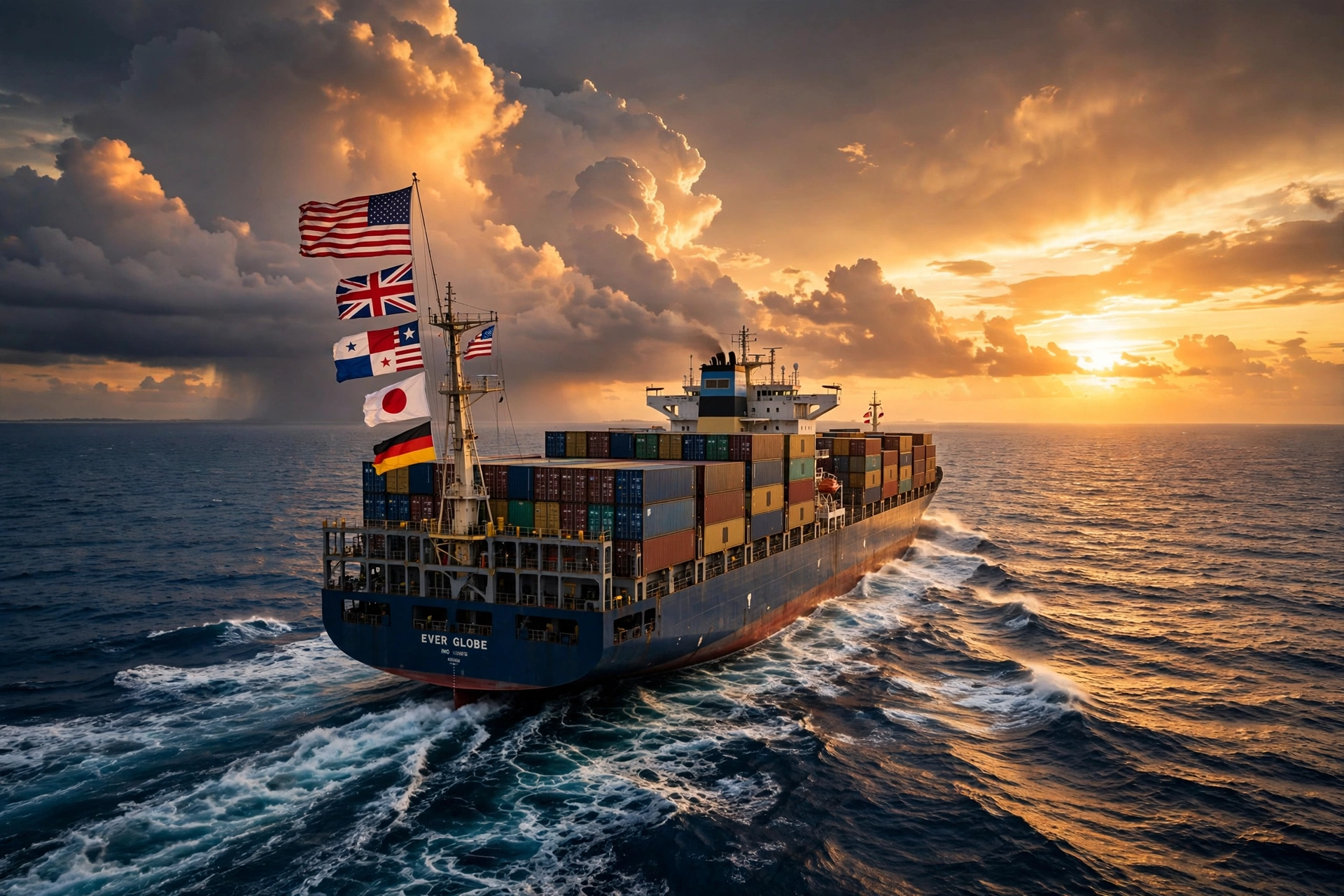

Every merchant ship in the world has a “nationality” — shown by the flag flown at its stern. That flag is not decoration: it decides which country’s laws apply on board, which safety standards are used, and where seafarers can turn when something goes wrong. For seafarers signing on to foreign ships, understanding what a ship’s flag means is as important as reading the contract.
Why Every Ship Has a Flag
Under the international law of the sea (UNCLOS), every ship must be registered in one country — the flag state. Registration gives the ship its “nationality”: a Panama-flagged ship follows Panamanian law, a Marshall Islands-flagged ship follows Marshall Islands law, and so on. Without a valid flag, a ship is considered stateless and can be detained in any port.
Shipowners are free to choose their country of registration — it does not have to be where the owner lives or where the ship trades. That is where open registries come in: countries that open their registers to foreign-owned ships.
What Flag States Are Responsible For
UNCLOS requires flag states to exercise jurisdiction over their ships. In practice, under the IMO framework, a flag state is responsible for:
- Ship safety — construction standards, safety equipment, and the ISM Code.
- Crewing — certification requirements (STCW), working hours, and minimum working conditions (MLC 2006).
- Seafarer certification — issuing endorsements for foreign seafarers serving on its ships, for example a Marshall Islands endorsement of an Indonesian Certificate of Competency.
- Enforcement — investigating accidents and punishing violations on its ships.
How strictly each country enforces these duties varies — and that is where a flag’s reputation is made or lost.
Flags of Convenience: Why Three Countries Dominate
Some countries run open registries with low fees, low taxes, and fast processes. This practice is known as flags of convenience (FOC). The three largest open registries in the world today are:
- Liberia — the world’s largest ship flag, at 317.4 million gross tons (Clarksons, September 2026).
- Marshall Islands — second in the world at 212.7 million GT, having just overtaken Panama.
- Panama — 196 million GT; the world’s No. 1 flag for 30 years until Liberia overtook it in 2023, now down 15% in the past year.
Together they account for around 45% of the world’s merchant tonnage. Their fleets are also young: the Marshall Islands averages 12 years and Liberia 12.6 — far below Panama’s 19.5.
The 5 Largest Ship Flags in the World
Per UNCTAD’s Review of Maritime Transport 2025 (as of 1 January 2025, share of world tonnage):
| Rank | Flag State | Share of World Tonnage |
|---|---|---|
| 1 | Liberia | 17.4% |
| 2 | Panama | 15.2% |
| 3 | Marshall Islands | 12.5% |
| 4 | Hong Kong, China | 8.3% |
| 5 | Singapore | 6.2% |
Note: Clarksons data from September 2026 shows the Marshall Islands has since overtaken Panama for second place.
What It Means for Seafarers
- Which law applies. Employment contracts, rest hours, and leave rights follow the flag state’s law — not your home country’s. Read the contract with that in mind.
- Certificates need endorsement. A national Certificate of Competency does not automatically work on a foreign ship; the flag state issues an endorsement for it. Make sure the process goes through an authorized filing agent.
- MLC 2006 minimum standards. All major flag states have ratified the Maritime Labour Convention — so basic rights such as full wage payment, repatriation, and decent accommodation are covered by the convention.
- ITF protection. On FOC ships, the ITF sets minimum wage standards through collective bargaining agreements.
The ITF and the Flags of Convenience List
The International Transport Workers’ Federation (ITF) defines an FOC ship as one flying the flag of a country other than its true ownership. The ITF maintains an FOC list — 48 countries as of 2025, after Dominica, The Gambia, and Niue were added. FOC ships make up about 30% of the world’s 100,000+ merchant vessels.
The ITF runs a network of 130 inspectors in 125+ ports worldwide checking wages and working conditions on FOC ships — and about 47% of FOC vessels are covered by ITF collective bargaining agreements. If your wages are below standard or something goes wrong on an FOC ship, an ITF inspector at port is one place to turn.
How to Check a Ship’s Flag and Track Record Before Signing On
- Equasis (equasis.org) — a free database to check a ship’s flag, owner, and inspection history from its IMO number.
- Port State Control history — ships frequently detained by port inspectors (e.g. under the Paris MoU or Tokyo MoU) are a warning sign; flags with many detained ships land on grey or black lists.
- Ask the manning agency — a legitimate agency must be transparent about the ship’s flag, owner, and trading route before you sign a contract.
- Beware offers with no clear ship name — if an agent won’t name the ship or its IMO number, that’s a red flag.
Tips for Seafarers
- Big flags (Liberia, Marshall Islands, Panama, Malta, Bahamas) generally have orderly administrations and global recognition — not a guarantee, but a good starting point.
- An unfamiliar tiny flag + sky-high wages + a rushed process = a combination worth suspecting.
- Keep copies of your contract, the ship’s IMO number, and ITF/seafarer union contacts before departure.
Prepare your CV before applying: read our guide to a seafarer CV that gets noticed by crewing — or chat with us on WhatsApp at +62 896-5739-1260 if you’d like help writing one.
Sources: UNCTAD — Review of Maritime Transport 2025; Splash247 — Panama slips to third in global flag rankings; ITF Seafarers — Flags of Convenience; World Ports Organization — New Flags of Convenience.